WhatsApp WhatsApp Us +852 95076045
FREE TOOL · HONG KONG BUSINESS BANKING FIT CHECKER

Find the right banking route for your Hong Kong company

QUICK ANSWER

The right business banking route depends on how your Hong Kong company operates, where it receives and sends money, the currencies it uses, the facilities it needs and how prepared it is for account-opening checks.

Answer 10 questions about your business activity, expected transactions, banking requirements, account-opening timeframe and onboarding preferences. Get a preliminary indication of whether a traditional bank, an online/fintech provider, or a combination of both may better fit your business.

10 practical business questions
Personalised banking-fit assessment
Separate application-readiness check
No signup required
Preliminary guidance only. This checker does not recommend a specific financial institution, guarantee account opening or predict whether an application will be approved.
Reviewed by Captime’s TCSP-licensed Hong Kong team (Licence No. TC010212) · Editorial standards · Updated October 2026
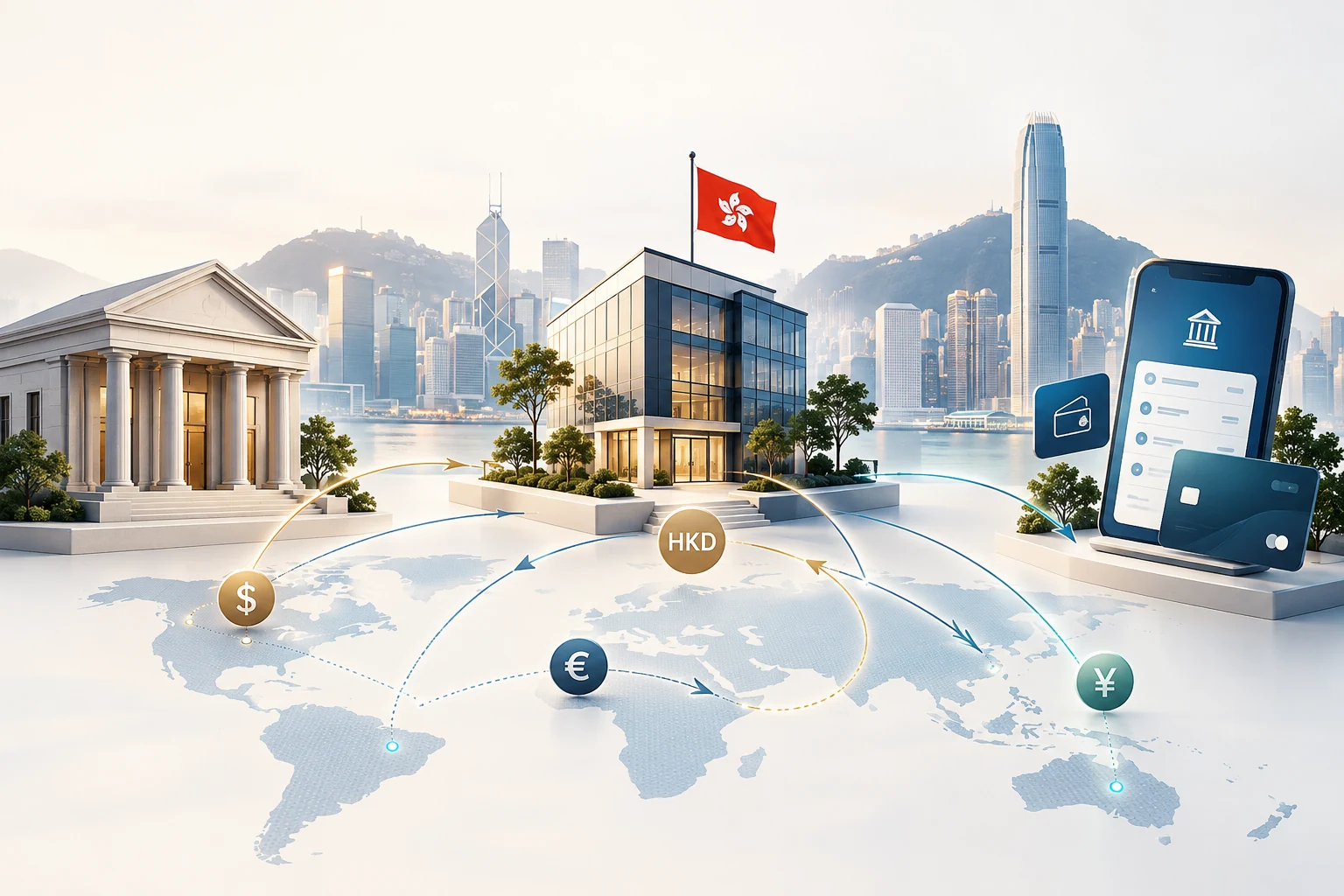
Hong Kong business banking fit checker — visual comparing traditional bank relationship banking with online fintech multi-currency and international payment routes
Focus on actual banking needs The assessment separates operational banking fit, broader banking facilities and application readiness instead of treating one preference as decisive.

Your preliminary banking assessment

Ready to begin

Traditional banks and online financial platforms can both support Hong Kong companies, but they do not always solve the same business needs. This assessment considers your operating profile, expected account activity, currencies, international payment requirements, banking facilities and application readiness.

YOUR BANKING FIT

Why you received this result

What to consider next

Discuss my banking options with Captime →

This result is a preliminary indication based solely on the information selected. Each provider applies its own eligibility, onboarding, KYC/KYB, compliance and risk-assessment procedures.

The assessment focuses on how your business actually needs to bank — not simply whether it prefers a bank or a fintech provider.

01

Operational banking fit

Where your company operates, where customers and suppliers are located, how it expects to transact and which currencies it needs to manage.

02

Banking capability requirements

International payments, FX and digital integrations are considered separately from trade finance, credit, branch services and relationship banking.

03

Application readiness

Supporting business evidence is assessed separately so documentation strength is not confused with the banking route that may fit the company.

How Captime assesses banking fit for a Hong Kong company

Assessment methodology last reviewed: 1 October 2026 (v8.2). Four independent dimensions are used: digital/fintech route fit, traditional-bank route fit, application readiness, and individual-review handling.

Captime's Hong Kong Business Banking Fit Checker uses ten questions to assess the key operational, banking and application-readiness factors relevant to a company's banking route. Requirements that directly affect account use — including international payments, multi-currency management, trade finance, credit facilities and branch-based banking — carry greater relevance than general profile characteristics. The assessment also considers how quickly the company needs an operational account and whether an in-person Hong Kong onboarding step would be practical. Application readiness is scored separately from route fit, so limited documentation does not automatically push a company toward either provider model. Ownership, control and industry/compliance considerations may also be derived from relevant answers and can trigger additional context or individual review rather than being treated as separate questions.

Four-part assessment: Digital/fintech fit and traditional-bank fit measure service requirements; application readiness measures how prepared the company is to explain and evidence its business; an individual-review flag is used where a general automated conclusion would be inappropriate. The checker does not calculate approval probability.
Business stage

Newly incorporated, early-stage or established trading history.

Business activity

The company's principal commercial activity and operating model.

Customer & supplier geography

Whether activity is mainly local, regional or international.

Expected account activity

How the company expects to receive, hold and send business funds.

Currency requirements

Whether operations are mainly HKD-based or multi-currency.

Hong Kong operating connection

How Hong Kong fits into the company's commercial operations.

Application readiness

Whether the company can support its activity with commercial evidence.

Banking capabilities

Digital payments and FX, broader banking facilities, or both.

Account-opening timeframe

How quickly the company needs an operational business account.

Onboarding practicality

Whether travelling to Hong Kong for an in-person onboarding step would be practical if requested.

Derived review consideration: ownership & control

Relevant ownership and control considerations may require additional context during provider onboarding; this is not a separate checker question.

Derived review consideration: industry & compliance

The business-activity answer may indicate that additional banking, licensing or compliance review is appropriate; this is not a separate checker question.

The ten questions used in the banking-fit assessment

The full assessment scope is available as normal page content so search engines and AI systems can understand what the checker evaluates even without interacting with it.

  1. What stage is your Hong Kong company at?
  2. Which best describes your company's main business activity?
  3. Where will most of your customers and suppliers be located?
  4. How do you expect to use your business account, and what level of activity do you expect?
  5. Which currencies will your business regularly receive, hold or pay?
  6. What operational connection will your business have with Hong Kong?
  7. How much evidence of your business activity could you currently provide?
  8. Which banking capabilities matter most to your company?
  9. How soon does your company need a business account to be operational?
  10. If required during account opening, would you be able to attend an in-person meeting or verification in Hong Kong?

Examples of how different Hong Kong companies may compare banking routes

These examples illustrate how the checker weighs practical banking needs. They are not provider recommendations, eligibility decisions or predictions of account approval; actual onboarding requirements vary by institution and company profile.

International e-commerce company

Example profile: Overseas customers, Asian suppliers, regular USD/HKD receipts and payments, frequent FX needs, no trade-finance requirement and a preference for remote onboarding.

How to interpret it: An online/fintech route may be worth prioritising where international payments, multi-currency management and digital access are the main requirements, subject to provider eligibility and onboarding checks.

Import/export trading company

Example profile: Regional suppliers and customers, documentary trade needs, possible working-capital requirements, a meaningful Hong Kong operating connection and willingness to complete additional onboarding steps.

How to interpret it: A traditional banking route may be worth prioritising where trade finance, lending, branch services or relationship banking are materially important.

International consulting company

Example profile: Foreign clients, multi-currency receipts, straightforward operating expenses, no immediate borrowing requirement and interest in both relationship banking and efficient international payments.

How to interpret it: Both routes may be worth comparing when the company can benefit from digital money-management capabilities while also valuing broader banking services or a conventional banking relationship.

How to read your preliminary banking-fit result

Results use the four-dimension model introduced in v8.2 (last reviewed 1 October 2026). No result predicts whether any specific institution will open an account.

Online/Fintech Route Worth Prioritising

Used when digital, international-payment and multi-currency requirements materially outweigh the need for broader traditional banking facilities.

Traditional Banking Route Worth Prioritising

Used where facilities such as trade finance, lending, branch services or relationship banking are materially important.

Both Routes Are Worth Comparing

Used when both digital money-management capabilities and broader banking facilities are relevant, or neither route clearly dominates.

Individual Banking Review Recommended

Used where the activity or structure requires more context than a general automated banking-fit assessment can reliably evaluate.

Traditional bank or online/fintech provider for a Hong Kong company?

Neither route is automatically better for every Hong Kong company. Online financial platforms can be particularly relevant to international payments, multiple currencies, foreign exchange, cards and digital workflows. Traditional commercial banking may become more relevant where a company requires trade finance, lending, branch-based facilities or a broader banking relationship. Some companies may benefit from using both. Note that “fintech” or “online” providers can include payment institutions and electronic money institutions operating under different regulatory frameworks from licensed banks; deposit protection and product scope can differ.

Business need Traditional bank Online/fintech provider
Everyday business paymentsCommonly availableCommonly available
International paymentsAvailableOften a core capability
Multi-currency and FXAvailableOften a core capability
Corporate cardsAvailableCommonly available
Digital integrationsVaries by providerOften a core capability
Trade financeCommon commercial banking serviceProvider-dependent
Business lendingSubject to eligibilityProvider-dependent
Branch/cash/cheque servicesAvailable depending on bankUsually limited or unavailable
Relationship bankingAvailable for qualifying customersDifferent support model
KYC/KYBRequiredRequired

What information may be required to open a Hong Kong business bank account?

Corporate account opening generally requires information that allows the bank to understand the company, its ownership, why the account is required and how it is expected to be used. Depending on the institution and application, this can include corporate identification documents, business addresses, beneficial ownership and control, authorised persons, the nature of the business, account purpose, expected activity and additional information relevant to the requested services or risk assessment.

Can a Hong Kong company with non-resident directors apply for a business bank account?

Having non-resident directors or beneficial owners does not by itself determine whether a corporate account application should be accepted or rejected. The wider customer profile, purpose of the relationship, business model and mode of operation remain relevant. Individual institutions still apply their own onboarding procedures, eligibility requirements and risk assessments.

How can a Hong Kong company prepare for business account opening?

A well-prepared application should make it easy for the provider to understand what the company does, who owns and controls it, why the account is required and how money is expected to move through it.

Company & ownership

Corporate records, beneficial-owner information and authorised-person details.

Commercial evidence

Business description, website, customers/suppliers, contracts, invoices or orders where available.

Expected account use

Transaction volumes, countries, currencies, source and purpose of funds, and required services.

What should businesses understand before choosing a banking route?

“A fintech account means no KYC.”

No. Online financial platforms conduct customer and business verification and may request company, ownership and intended-activity information.

“Foreign directors make account opening impossible.”

No. Non-resident directors are one part of the wider customer profile and do not by themselves decide the outcome.

“The checker tells me who will approve me.”

No. The checker assesses banking-route fit. Each provider makes its own onboarding and account-opening decisions.

Hong Kong business banking questions

Does a Hong Kong company need a Hong Kong bank account?

There is no general rule that every Hong Kong incorporated company must keep its business account with a Hong Kong bank. The practical question is whether the account setup supports the company’s real operations: receiving customer payments, paying suppliers, holding the currencies it uses, making local or cross-border transfers and keeping business transactions clearly separated from personal funds. A Hong Kong bank account can be useful for businesses with substantial Hong Kong activity, but an overseas or regulated digital-payment account may also form part of the banking setup where it supports the required currencies, payment routes and services. The company should still check the provider’s eligibility, legal status, account features and any accounting or compliance implications before relying on it.

Which is better for a Hong Kong company: a traditional bank or a fintech provider?

Neither route is automatically better. The stronger fit depends on the services the business actually needs. A traditional commercial bank may be more suitable where the company needs facilities such as trade finance, lending or credit, cheque or cash services, or a broader relationship with a bank. A digital or fintech-led provider may be attractive for multi-currency balances, foreign-exchange workflows, international payments, corporate cards or software integrations, depending on the provider. Businesses with mixed needs may use both. Compare the exact product, fees, supported currencies and jurisdictions, regulatory status, safeguarding or deposit arrangements, and eligibility requirements rather than choosing solely on the “bank” or “fintech” label.

Can a newly incorporated Hong Kong company apply for a business account?

Yes. A newly incorporated company can apply, but being incorporated does not by itself guarantee account opening. Because a new company may have little or no transaction history, the provider may rely more heavily on information explaining what the business will do and how the account will be used. Useful supporting material can include incorporation and ownership records, a clear business description, website or business materials, contracts or orders where available, expected customers and suppliers, intended transaction countries and currencies, and reasonable estimates of account activity. The exact evidence requested depends on the provider and the circumstances of the application.

Can a foreign or non-resident director open a Hong Kong business bank account?

A company should not be treated as ineligible merely because its directors or beneficial owners are non-residents. Hong Kong Monetary Authority guidance states that account-opening applications should not be rejected merely because a corporate customer is established offshore or has non-resident directors or beneficial owners. The institution may still need to understand the reason for the Hong Kong banking relationship, the company’s business model and mode of operation, its ownership and control, and the people authorised to act for it. Residence is therefore one part of the overall customer profile rather than an automatic approval or rejection test.

What documents and information may be required for a Hong Kong corporate bank account?

Requirements differ by institution and customer profile, but corporate onboarding commonly covers several areas. A provider may ask for documents that establish the company’s identity and incorporation, its registered or business address, ownership and control structure, beneficial owners, directors or authorised representatives, and the authority of the person opening the account. It may also ask about the nature and purpose of the business relationship, expected account activity, transaction countries and currencies, customers or suppliers, and supporting commercial evidence such as contracts, invoices, orders or business materials. Additional information can be requested where necessary for customer due diligence or the services being applied for.

Is a fintech business account the same as a traditional bank account?

No—not necessarily. “Fintech” describes a technology-led delivery model, not one single legal type of account. A fintech platform may provide payment, multi-currency, foreign-exchange, card or collection services under a regulatory framework that differs from that of a licensed bank. As a result, deposit protection, safeguarding arrangements, credit facilities, cash or cheque services and other features can differ materially. Before opening an account, a company should identify the legal entity providing the service, its regulatory status, how customer funds are held or safeguarded, which currencies and payment routes are supported, and which services are excluded.

Can my company use both a traditional bank and a fintech provider?

Yes, subject to each provider’s eligibility and terms. Some companies use a traditional bank for core banking, local payments, financing or trade-related facilities while using a digital provider for specific functions such as multi-currency collections, foreign exchange, international transfers, cards or integrations. A dual-provider setup can add flexibility, but it also means the business must reconcile transactions across accounts, maintain clear accounting records and complete each provider’s separate onboarding and ongoing compliance requirements. The right structure depends on operational needs rather than on having as many accounts as possible.

How long can Hong Kong business account opening take?

There is no single guaranteed timeframe. Processing time varies by provider, the company profile, the services requested, the completeness of the application and whether additional due-diligence steps are required. Some digital or fintech-led providers advertise comparatively fast onboarding for eligible businesses, while bank applications can take longer where additional review is needed. Treat any stated timeframe as provider-specific rather than guaranteed, and confirm the current process directly before applying.

Can a Hong Kong corporate bank account be opened remotely?

Remote corporate onboarding is possible with some Hong Kong banks and other providers, but it is not a universal entitlement and the process varies. HKMA guidance permits remote onboarding frameworks while still requiring appropriate customer due diligence. For a corporate customer, this can include verifying the company, the authorised representative and beneficial owners, and understanding the ownership and control structure and nature of the business. A provider may use video identification, electronic document verification, digital signatures or other controls, and may still request further documents or an in-person step where its procedures or the customer profile require it.

Do all directors and beneficial owners need to be physically present when a corporate account is opened?

Not as a general HKMA requirement. HKMA guidance explains that a corporate account is generally opened by an individual authorised to act for the company; the institution must identify and verify that person and confirm the authority to establish the relationship. Information about directors, beneficial owners and other connected parties may still be required as part of customer due diligence, and a bank can apply additional verification procedures under its own onboarding process. This means “not everyone must attend” should not be confused with “no identity or ownership checks are required.”

Does Captime recommend a specific bank or guarantee account opening through this checker?

No. This checker compares the company’s stated operational needs with broad characteristics commonly associated with traditional banking and online or fintech-led services. It does not rank or endorse individual institutions, determine whether a particular provider will accept the company, or replace that provider’s onboarding assessment. The final decision rests with the institution after it applies its own eligibility rules, customer due-diligence procedures, KYC/KYB checks, compliance controls and risk assessment. A “good fit” result therefore indicates a route worth exploring—not an approval prediction.

Continue planning your Hong Kong company

Hong Kong Company Fit Checker

Assess whether Hong Kong fits your wider business model, commercial footprint and operating plans.

Check company fit →

Hong Kong Offshore Profits Tax Checker

Review where your active profit-producing operations take place and whether your profile shows offshore-source indicators.

Check offshore indicators →

Talk to Captime

Discuss your operating profile, expected transactions, banking requirements and application readiness.

Contact Captime →

Important scope limits

This checker provides a preliminary assessment of business banking-route fit based solely on the information entered. It does not provide banking, financial, legal or regulatory advice; rank individual financial institutions; confirm provider eligibility; or predict whether an application will be accepted. Traditional banks and financial platforms can operate under different regulatory frameworks and offer materially different products.

Discuss the banking needs of your Hong Kong company.

Captime can help you review your company's operating profile, expected transactions, banking requirements and application readiness before you approach suitable business banking providers.

Talk to Captime →
WhatsApp WhatsApp Us +852 95076045
WhatsApp Us